



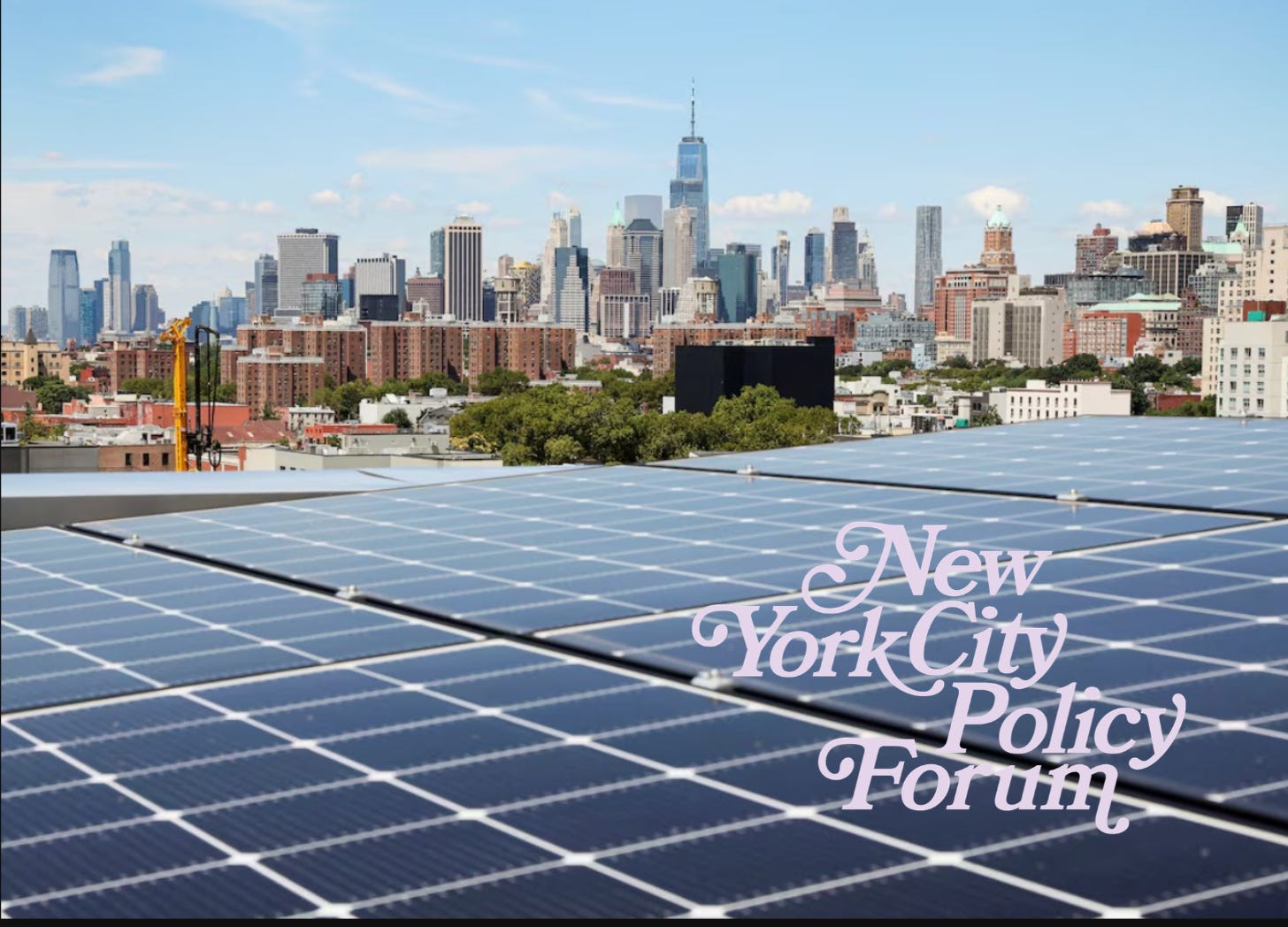
Jason Kowalski and Johanna Bozuwa make the case for a new public institution that would bring benefits to workers and communities by accelerating the deployment of community-scale energy infrastructure, including: distributed battery storage, distributed solar, and thermal energy networks.
New York City faces overlapping energy crises. Electricity bills are rising, and growing demand for electricity threatens to push costs even higher. At the same time, the climate crisis is hitting the city—and its power grid—hard. This July, heatwaves roiled the electricity grid—leaving nearly 10,000 people in Queens without power and forcing ratepayers across the city to choose between safe temperatures and spiking bills. Now, as winter approaches, New Yorkers are facing higher heating bills, with state data showing that the price of heating oil has risen 69 percent since last year. Meanwhile, addressing the existential threat of climate change grows more urgent each day. NYC needs creative, ambitious approaches to tackle multiple overlapping crises at once.
In our new report, “PowerNYC Development Corporation: The Case for a Public Renewable Energy Developer in New York City,” we propose creating PowerNYC, a public renewable energy developer that would build clean energy infrastructure, lower electricity costs, and create good union jobs.
New York City does not lack clean energy project opportunities. What it lacks is a public institution with the capital, mandate, and development capacity to systematically turn these opportunities into operating projects.
PowerNYC would fill this gap by developing and potentially owning distributed batteries, rooftop solar, and thermal energy networks across the five boroughs. It would provide a turnkey solution for affordable housing providers and other community institutions to get clean energy projects built at no upfront cost.
The affordability benefits could be substantial. Our analysis finds that an initial deployment of 200 megawatts of publicly developed batteries could save ordinary New York City electricity customers over $170 million per year.
PowerNYC would establish a financially self-sustaining engine of decarbonization. By developing revenue-generating assets, the City could turn an initial public investment into a permanent source of clean energy development capacity. For example, contracted revenues from one round of projects could be used to back publicly-issued revenue bonds that finance the next round of projects.
PowerNYC represents a new paradigm for U.S. clean energy policy: shifting economic planning responsibility from the private sector into the public sector to build essential projects that markets alone are not delivering.
But the underlying model is not new. Public development has long been used to build essential infrastructure, and the Connecticut Green Bank has taken a similar public-led approach for deploying distributed solar and battery storage. Like the public finance institutions that built our water systems, airports, and public schools, public renewable energy developers can deliver essential infrastructure at scale while delivering tangible benefits for working people. In doing so, PowerNYC would demonstrate what is possible for New York and provide a model for the nation.
We recommend an initial $100 million investment from New York State to launch PowerNYC. With the right public institution, New York City can lower costs, accelerate decarbonization, and build a clean energy future that delivers for all New Yorkers.
Jason Kowalski is the Executive Director of the Public Renewables Project. Johanna Bozuwa is the Executive Director of the Climate and Community Institute.
Curious why we shouldn’t just fund the existing developers in NY? What would a publicly-owned developer do better?