


With the midterm elections around the corner, politicians, pundits, and policy wonks across the political spectrum have been touting “affordability” as the key theme of American politics. But with the word being used to advocate for everything from tax cuts to deficit reduction, there is little consensus about what it really means—or how to address it. As the cost-of-living crisis continues to plague working class households, a clear program and policy suite to meet popular demands for economic relief remains to be defined.
Here in New York City, Elle Bisgaard-Church, Chief of Staff to Mayor Zohran Mamdani and the manager of his primary campaign, explains how the administration is translating its winning cost-of-living focused campaign into governing practice: a democratic socialist approach to affordability, focused on lowering costs and expanding all people’s ability to flourish.
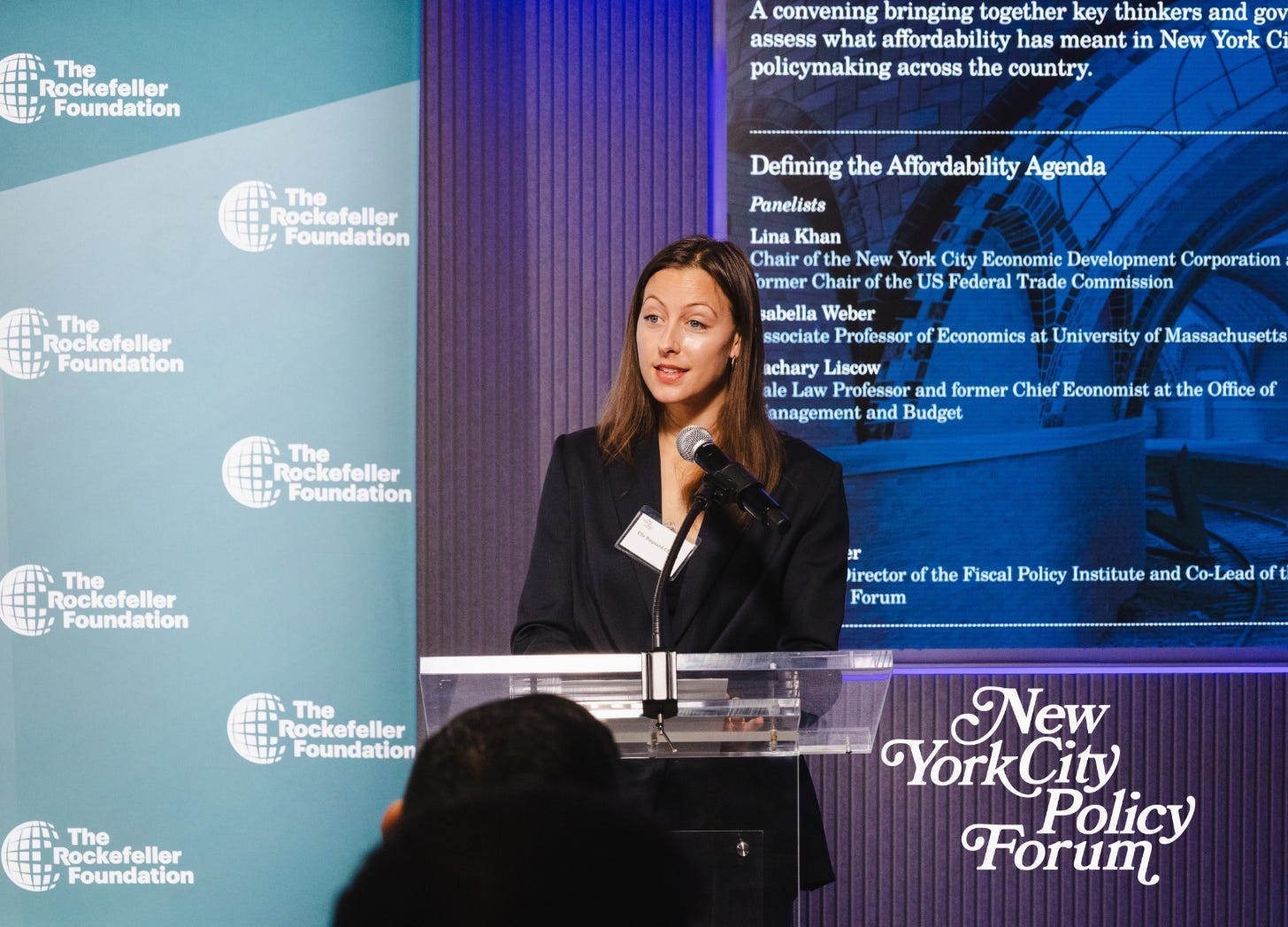
This article is adapted from remarks delivered by Bisgaard-Church at a New York City Policy Forum event on October 26, 2026. A full recording is available here.
We launched Zohran Mamdani’s campaign for New York City mayor two years ago with a video that asserted “the cost of living is the real crisis.” For years, in Zohran’s State Assembly office, we had heard from constituents about the costs of their housing and utility bills. We had enrolled our neighbors in Fair Fares, housing affordability programs such as SCRIE and DRIE, SNAP, the Energy Affordability Program, cash assistance, and more. We knew New Yorkers were hurting, and we believed that the government had to do more. While we had already identified distinct failures from the Adams administration, we also had to grapple with forces upstream of the cost of living, and we knew that any commensurate solutions would need to boldly confront asymmetries of money and power.
What was to be done? We began to discuss how exactly our campaign’s policy platform could address the cost of living crisis, particularly within a local context subject to national and global headwinds. We started by considering the top costs facing ordinary New Yorkers, and the City’s ability to intervene directly or indirectly. We knew we wanted to center the campaign around three core commitments, and so our own robust internal debate over prioritization began: we studied child care, housing, transit, utilities, internet, and groceries, as well as progressive taxes and public ownership.
There are numerous technical and political considerations that went into designing our policy platform, but I want to revisit what grounds our focus on “affordability,” especially as it’s now become a somewhat anodyne tagline used by politicians across the country, many of whom do not share our analysis or our ambitions.
Affordability is, in the first instance, a way to emphasize ordinary people’s needs. To us, “affordability” implies a whole politics of needs, and requires grounding our political perspective in the concrete material interests that are lived and of immediate concern to the majority of our constituency. This is foundational because needs are both a condition for and a measure of human flourishing. If you can’t meet a basic need such as the ability to pay for the bus or care for a child, how can you ever dream of anything better for your life?
And that is why the campaign slogan “A City You Can Afford” was neither a fixed nor abstract endpoint. The phrase is meant to initiate public deliberation about how the government can become a transparent and rational instrument of collective self-determination. That will involve strengthening public institutions and increasing democratic participation—not as pious hopes, but as integral to our own standards of political success. When the public articulates a problem, imagines possible alternatives, and experiments with various solutions, we achieve better outcomes. Moreover, programs that are organically democratic are more likely to stick: they hold up better, are implemented more effectively, and ultimately endure because the people who built them and the people who benefit from them are one and the same.
But the public experiencing itself as an effective social agent is, we believe, also a good in itself: democratic participation both models and realizes the society we as democratic socialists want to create. That society is one in which people are sufficiently empowered to author their own collective futures, not one in which they have to depend on the goodwill of the powerful to meet their basic needs. That’s why we look especially to universal social programs, expanding forms of public ownership, and supporting the growth of unions—in short, creating shared economic institutions that yield security and stability. We steer away from means-tested programs, which divide and encumber people; from one-time hand-outs, which disempower people from long-term planning and sustainable decision-making; and from private sector capture, which extracts wealth and tilts programs away from public welfare.
Our administration insists that affordability and democracy are intertwined and even mutually reinforcing. With free childcare and affordable rent, we enable people to participate in self-government. With more money in their pockets and greater peace of mind, we restore trust such that ordinary people both can and want to participate in democratic processes. Ultimately, people who experience government as capable of realizing their own concrete needs—and who understand the mechanics behind it once they are made less opaque—can then demand more, and imagine still further what new forms of flourishing might best express their hopes.
From the Zohran for NYC campaign to the Mamdani Administration, we have set our sights on creating a more free society and building a mobilized, empowered constituency.
We are by no means the first to dream of a New York City for the people. We stand in a long tradition of people who believe that New York need not belong only to the few. In the post-war era, the City protected deep social rights and celebrated rich public institutions, including NYCHA, CUNY, and the MTA. But today our democracy has been eroded by the rule of austerity, and we face a withered welfare regime, means-tested policies, a decayed public sector and weakened public institutions.
Such are the political realities our campaign was elected to change. We believe that lowering the cost of living is the fundamental first step in that task.
The messaging discipline around affordability is truly impressive. It’s a winning message for sure. I think what’s really missing from their narrative is an affirmative view of business and commerce. You can actually create value, you can grow the pie by creating products and services that people wanna buy. You can even make profit off of those things while making your customers very happy and improving their lives. Instead of growing the pie, the Mamdani admin seems to be primarily about extraction— extracting resources from individuals or companies who have them through taxation and regulation. I’m onboard with the Mamdani affordability messaging if you include an affirmative view of value creation through running and operating profitable businesses. Instead of focusing on how you will open the public purse to close the affordability gap, create conditions for value creation.