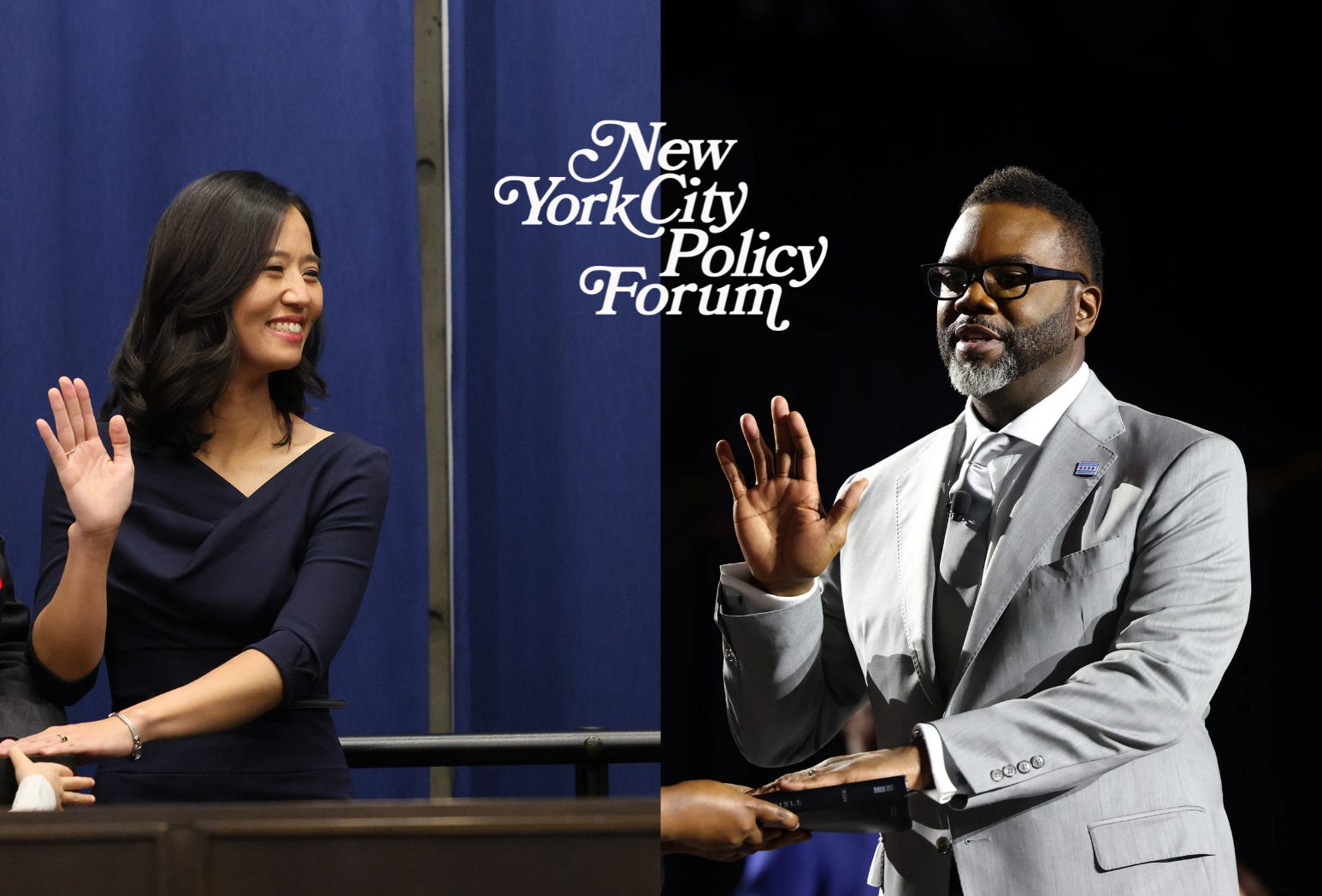
Much has been made of progressives winning the Mayor’s Office in Boston and Chicago, and now New York City and Seattle. Each case reflects profound differences in the cities’ political ecosystems, as well as the striking ideological diversity within even the leftmost wing of the Democratic Party coalition—democratic socialist and transit activists to Harvard-educated attorneys and public-sector union reformers. What has the experience of ascending to the Executive entailed? We asked officials from Mayor Johnson and Mayor Wu’s transitions—Emma Tai and Tali Robbins, respectively—for reflections on the transition to governing.
A previous post rounded up NYC-specific perspectives on transitions, read that here.
Chicago
There is a very illuminating chapter in Jane Mayer’s book Dark Money about President Obama’s first year, and the effort to pass the Affordable Care Act. She describes how in January of 2009, when Obama and his advisors were riding high on their plans to build a new post-partisan consensus, the Koch brothers assembled their network of Republican mega-donors to make a plan to destroy him–which as we all know turned into a serious political effort, leading to the rise of the Tea Party, the election of Scott Brown in Massachusetts, the town halls featuring “death panels,” and ultimately the Democrats’ catastrophic showing in the 2010 midterms. The point is that Obama’s opponents treated his victory as an existential threat to their power, and acted accordingly.
I saw the same thing happen in Chicago, where I was the Executive Director of United Working Families for seven years and served on now-Mayor Brandon Johnson’s Transition Committee in 2023. During that transition, there was so much rightful excitement: pulling together this historic transition report; planning the inauguration; naming City Council allies to important committee leadership roles; preparing bold executive orders; hiring organizers and movement actors into senior roles in the administration. And some of that excitement obscured that there were specific political and economic interests, both in Chicago and nationally, who saw the prospect of Black-led social movements and organized labor ascending to this level of political leadership in Chicago as either A) an existential threat or B) an incredibly convenient punching bag.
During the transition, we experienced the “existential threat” opposition as a sort of soft power: leaking and subterfuge intended to disrupt planning processes, withhold philanthropic funding, and shape hiring and appointments, all meant to put cracks in the new government’s mandate. The “punching bag” approach was then aggressively exemplified by Texas Governor Greg Abbott’s ongoing bussing of migrants from the border to Chicago. This manufactured crisis dramatically heightened the pressure on the administration and opened up very painful ruptures—including a set of City Council members who a few months into the Johnson administration started whipping votes to take away Chicago’s sanctuary city protections. (During the transition one of my assignments was to make a plan for what we would do if Abbott sent a load of buses to block traffic during the inauguration, to give you a sense of what we were managing.)
I don’t say this to deflect from missteps, but to emphasize that “governing” is not a static position. The power of a coalition aiming to govern is only as strong as its ability to stay a coalition—or how much power your opponents are willing and able to marshal to constrain you. It is critically important to be clear about your goals—because political strategy is about trade-offs, and executing on your goals necessarily has at minimum an opportunity cost (the time spent on that vs. time spent on other things) but also often has real political cost.
There are plenty of examples here: candidates tack to the middle in the hopes of winning a general election, but alienate their base; you make a deal on a package of legislation to get the votes, but weaken the bill in it the process; you take on one issue first and then the partisans of the other issue are mad that they didn’t go first; the list goes on. And there are different kinds of goals, too. Are you trying to elevate one leader for a future move to higher office? Are you trying to pass specific legislation? Are you trying to build new donor bases nationally? Are you trying to fix one dysfunctional department, or reform the procurement system, or build a successful policy model and broadcast its success nationally
The senior strategists, including both staffers inside the administration and organizers on the outside, should be in as much agreement as possible about those goals. That means working towards a shared understanding of how these goals, as opposed to other possible ones, are going to help working people build and consolidate more power, while weakening our opponents’ ability to stop us. There is just so much incoming during a transition, and during an administration, that being as clear as possible on those trade-offs, with an inner circle that is loyal to those goals, and a clear decision-making structure for who has the final say, is critical.
Many on the left often speak about elected officials as cowards or sell-outs who break their campaign promises. And obviously in some cases, that’s fair. But I also think that’s a very individualized understanding of power, where we need a structural one. No one person has absolute power; an executive office is not a fixed thing that any one person or group of people can just grab and hold. We are constrained by the forces that act on us, which means that any left political and electoral project has to be about shaping those forces over the long-term. If you’re not clear-eyed about that, you can easily fall prey to the idea that we can build political majorities simply by electing good people or demonstrating the self-evident benefit of delivering good policies. If that were the case, we wouldn’t always be fighting for living wages, good healthcare, good jobs, good education. The clearer we can be about the fact that it’s always about power, and therefore about struggle and trade-offs, the more effective we will be.
Emma Tai is the former Executive Director of United Working Families in Chicago, who led the citywide field program to elect Mayor Brandon Johnson and served on his transition team.
Boston
Mayor Wu’s transition into office in 2021 was unique. First, Boston was being led by an acting mayor because Marty Walsh, the former mayor, had been appointed labor secretary under President Biden in January. (The Boston City Council passed legislation waiving a special election, so instead of getting sworn in in January, as usual, Mayor Wu assumed office two weeks after the traditional November 4 election.) Second, it took place during the Covid-19 pandemic. So, for us, transition and beginning to govern were really the same period. It wasn’t until about seven months into the administration that we had our full team in place. During a single week in June of 2022, we passed our first budget, passed our American Rescue Plan Act package, hired our superintendent, hired the police commissioner, and threw our inauguration party, which had been delayed because of Covid.
The compressed timeline and the nature of the problems we were facing—especially Covid—led us to make some strategic short-term hires. One very specific example, most of the unsheltered homelessness in Boston was concentrated at the intersection of Massachusetts Avenue and Melnea Cass Boulevard. When we took office in 2021, there were significant encampments, substance use disorder, and public safety concerns at that location. We knew this would be an important test for the Administration and so we hired someone from the state public health world to be the sort of “Mass. and Cass czar.” She was really respected in the field and brought deep government experience—but was not interested in a permanent position. She committed to six months of super credible work, which gave us the opportunity to steady the ship and figure out how to staff the problem.
City government is closest to residents, and information must be able to filter up. We have neighborhood liaisons, and heading into the next term we’re focused on making sure that their feedback reaches decision makers who can actually move on it. Quality of life issues, from a park renovation to a speedbump, are opportunities for people to interact with the government in a way that makes a tangible difference. But it’s important to understand that the big policy agenda and the small-scale tactical stuff are fundamentally related—they’re both about the trust and support you need to govern.
Early into Mayor Wu’s term we held an event with principals from all the schools in Boston. One of the elementary leaders said that they had been trying to get the keypad on their backdoor changed because the door shuts and people get locked out. After that meeting, I made a call and worked with the facilities team to get a keypad installed—so people would stop getting locked out! This was an important moment for me. Mayor Wu’s line when we came in was “do big things by getting the small things right” and that has remained our philosophy.
Tali Robbins is the Deputy Chief of Policy for Boston Mayor Michelle Wu.