


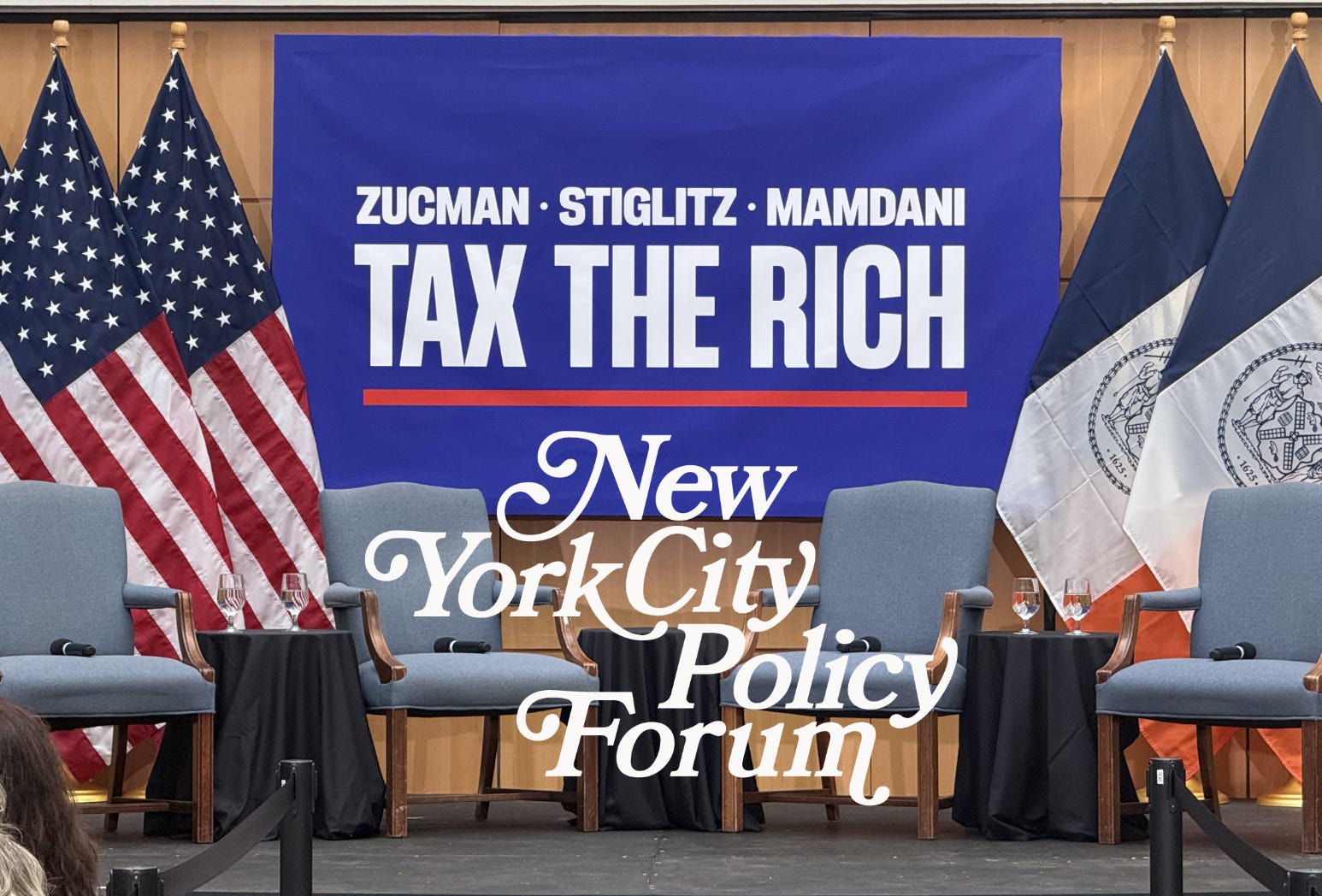
On Tax Day at the CUNY Graduate Center, International Affairs Commissioner Ana María Archila hosted Mayor Zohran Mamdani, Nobel laureate Joseph Stiglitz, and economist Gabriel Zucman for a conversation about wealth inequality, extending their op-ed connecting tax debates in New York to multilateral tax negotiations being pursued around the world.
New York is in the middle of City- and State-level budget negotiations defined in part by the tremendous electoral and political salience of Mamdani’s campaign demand to fund an affordability agenda through increased taxes on high-earners. The surge in open debate over tax hikes joins years of path-breaking research and policy advocacy across the globe on inequality and tax—in which Stiglitz and Zucman have been leading figures—and significant advances in domestic and multilateral tax reforms.
It also builds on recent local efforts to break the global trend towards regressive taxation. In 2021, when Mamdani was in the state legislature, he joined a slate of newly-elected socialists to successfully push for increased taxes on corporations and those with personal income above $1 million.
In a wide-ranging discussion, the panelists argued tax is both the means by which broadly shared social programs and the foundations of economic growth are funded, and a tool to combat runaway inequality and its many downstream deformities.
The transcript has been edited for length and clarity.
Ana María Archila: Good morning everyone. Thank you all for making the choice to be here today, on Tax Day. (I hope you either filed or requested an extension!)
Today, a lot of people in this country are thinking about money and taxes. Where are their taxes going? Who’s paying and who’s not paying? If we’re all paying in, how come so many of us feel so squeezed?
This question is on the minds of people in this city, across this country, and everywhere around the world. And today’s conversation is about what it takes to actually address the urgent and global crisis of inequality—the global stakes are represented by those in the room today, with representatives from over forty countries across Europe, Asia, Africa, the Middle East, Latin America, the Caribbean, North America, and Oceania. Thank you so much for joining us.
Around the world people are struggling. Most people, millions, billions of people are struggling while wealth is accumulated in the hands of very few—the result of decades of economic and political decisions. And we know the concentration of wealth leads to the concentration of power, which means this conversation is about not only economic policy but also its effect on our democracy.
We’re going to hear from leading experts about the state of inequality today and some of the solutions that are necessary to address it—which draw inspiration from movements from around the world. The Office of International Affairs believes that New York City is a place where the world gathers, and therefore has an important role to play in the conversation about how to tackle these crises. And I am so grateful that today we are joined by Mayor Zohran Mamdani and two renowned guests: Professor Joe Stiglitz, Nobel Prize winning economist whose work has shaped the global understanding of inequality, and by Professor Gabriel Zucman, the founder of the International Tax Observatory, whose research on taxing extreme wealth is influencing policy debates across the world.
Professor Stiglitz, you recently collaborated with Professor Zucman and many others on the World Inequality Report. Can you help us understand what is happening right now? What is the current state of inequality in the world today?
Joseph Stiglitz: What you said before is right: We have a global inequality crisis. While it is very difficult to get an agreement among the G20 these days, there is broad consensus that there is a global crisis of inequality. And President Cyril Ramaphosa of South Africa asked me to chair a committee to look at the drivers and impacts of growing inequality across the globe.
The findings were staggering. Since the beginning of the twenty-first century, 41 percent of all the increase in wealth has gone to the top 1 percent, while the bottom 50 percent of the world has gotten just 1 percent of that increase in wealth.
The United States always likes to claim that it does better than other countries—and this is one area where we really do excel—across many dimensions, we have more inequality than peer countries do. And within the United States, New York excels. In this city, the average income of a New Yorker is about $131,000. If we all shared in that average income, we’d all live reasonably well, even with the affordability crisis you could get by on that. But it’s an average, and the problem is that a few people at the top are taking such a large fraction of that average—billions at the top, while the rest are well below it. That’s the struggle for so many New Yorkers.
Inequality has grown enormously over the past forty years. More people are struggling at the bottom, the middle class has been eviscerated, and what we’ve seen in recent years is the growth of oligarchy at the top and the incredible political influence that they have.
Recent research has shown that extreme inequality undermines economic performance and leads to social polarization—but perhaps most disturbing is the effect on our democracy, particularly in a system like ours which gives free reign to money in politics. We are a country better described as one dollar, one vote than one person, one vote.
One of the factors contributing to this growing inequality is the unfairness of the tax system, where those at the top, this is really quite remarkable, actually pay a smaller share of their income than those below.
President Trump has trumpeted his tax cut—probably the most regressive tax cut in history with huge gifts to billionaires and rich corporations. And miserly cuts for ordinary Americans were more than offset by cuts to ACA and Medicaid.
The wealthiest have not been paying their fair share since the middle of the century—when the average tax paid by the top earners was around 50 percent. Today it’s less than half that. On this tax day, April 15, let us resolve to correct this gross inequity. At least ask the rich to pay their fair share of taxes.
Gabriel Zucman: I want to follow and discuss some good news, which is that I think we are at the dawn of an international movement to actually fix some of the problems that Joe mentioned to finally make the super rich pay their fair share.
This has been helped by new research to establish the empirical fact that the top pays so little. We suspected for a long time that this was the case, but there is a great deal of opacity about the wealth of the super rich, the income they earn and the taxes they pay. And it’s really only over the last several years that we’ve begun to get a clearer picture.
The superrich pay much less tax relative to their income than other groups, often only half as much in tax as what the middle or working class does. Brazil has been a leader here, when they had the Presidency of the G20 and advanced the principle that extreme wealth should come with unavoidable duties towards society—namely, an unavoidable minimum tax for billionaires with a minimum tax equal to 2 percent of their wealth. Who can argue against this? It’s hard to argue that these individuals should not contribute as much as the rest of us, and so the idea is gaining momentum in many countries.
Last year in France, the National Assembly passed this 2 percent minimum tax on the super rich—which was then blocked by the Conservative Senate. In California, healthcare unions are leading on a billionaire tax. There are many more examples, and the breadth of these efforts underlines that it is not radical to ask the super rich to pay as much tax as the rest of the population. What is radical is to accept the status quo, in which the richest are allowed to live in their own parallel world, free of tax. That’s not acceptable. But we are going to fix the problem of international oligarchy through collaboration across governments and nations, and that’s why I’m so thrilled that we are having this conversation here today with the mayor in New York City.
Ana María Archila: Mayor Mamdani, right now you are leading your administration’s effort to make sure that every New Yorker has the opportunity to live with dignity. Can you give your reaction to the two presentations we just heard about the state of inequality, and the movement that is building to address it?
Zohran Mamdani: I think first and foremost, I just wanna say thank you Professors Stiglitz and Zucman for the immense amount of work and scholarship and advocacy that you’ve both done, which has allowed for this moment, for these ideas to be realized by so many in the fight for a fairer world. And continuing in your tradition of sharing good news, I’ll say that we are already seeing the fruits of that scholarship and advocacy.
Just last night it was announced that we are working together with the governor to introduce New York City’s first ever pied-à-terre tax, which will tax properties worth more than $5 million that are owned by people who do not reside in New York City—the super wealthy who can purchase properties and use them to store their wealth, benefitting from New York City’s real estate market, but often not paying back into the city that generates that wealth.
New York City compares itself to other global cities, as we should. But if we compare ourselves to Berlin and Madrid, we find we have 80 percent higher levels of inequality. If we speak honestly about the levels of inequality in this city, our counterpart is in fact Panama City in terms of the levels within that society.
We correctly describe New York City as the most expensive city in the United States of America. When we measure the true cost of living here, it shows that more than 5 million New Yorkers cannot afford it. 62 percent of New Yorkers cannot afford to live in this city.
And for all of the discussion of the imagined exodus that would take place if we taxed the wealthiest New Yorkers appropriately—and I say imagined because, as a state legislator I was a part of an effort to raise taxes on millionaires, and we now have more millionaires today, even after passing that tax—the real exodus we are seeing in this city is of working class people who cannot afford to live here. In a snapshot from 2000 to 2020, the city lost 200,000 of its black residents. That is the true cost of inaction on inequality, and so that also speaks to the urgency of this conversation and this advocacy. And it is representative of the fact that while inequality is a global issue, it is also very much a local issue here in New York City.
Ana María Archila: Thank you Mayor. You referenced one of the objections that we hear all the time about taxing the rich, which is this idea that the wealthy will flee. So Professor Zucman, you have done a lot of research on these very questions.
Gabriel Zucman: It is indeed largely a myth. It is frankly almost propaganda: anytime a government considers increasing taxes you hear this threat of outmigration. It is a way for the very wealth to say “no, you can’t tax us.” Even though the research is very clear, backed up by careful empirical studies looking at tax variation, increases and cuts, to see how this correlates with migration, the overwhelming conclusion is that it’s not the case. There is an extremely small response, much less than what you could infer if you are just reading the newspapers and the headlines.
In 2024, Massachusetts 2024 introduced a 4 percent surtax on million dollar earners. It has now generated billions more in revenue than what was projected. That is, I think, a good indication that we should be confident that, especially for a city like New York, a small extra tax on millionaires is unlikely to push them to flee the city.
And let me just say: if a couple of billionaires were to leave New York or Massachusetts, is that a problem? That’s not clear to me. And I very much agree with what the Mayor said. Perhaps New York can afford to lose a couple of billionaires, but it cannot afford to lose its working class.
Zohran Mamdani: Our vision is that everyone stays in the city and that we have room for others to join us in the city. The revenue that we would use from increased taxation is to increase the quality of life of the same city that we all call home.
Revenue becomes an investment back into the very things that New Yorkers measure as the efficacy of city government. We just had crossed our first hundred days mark. The Department of Transportation that filled in 102,000 potholes in that period of time—and I can personally attest to the fact that they’re doing it at all hours of the day, at midnight, in the morning, at every single hour of the day.
They can do this work because of the tax system that raises the revenue to fund this work. We often speak about aspects of the public sector as if they are guaranteed, and as if they have no relationship to how private wealth is generated, when in fact in many cases they are the foundations of economic activity.
And on the subject of migration, a study from the Fiscal Policy Institute found that the wealthiest New Yorkers leave at one fourth the rate of other New Yorkers. There’s a stronger correlation between being a new family that can’t afford childcare—twice as likely to leave as the average New Yorker— and leaving the city, than there is between new tax status and out migration.
Yesterday I was standing in front of a skyscraper on Central Park South, where Ken Griffin owns a penthouse that he bought for $240 million. This is the kind of wealth that is being stored in the city, and it is a residence that is so often empty. Not that many years ago, a developer told State Senator Liz Krueger, who represents that district, about a new building to come up and he said, don’t worry, no one’s actually going to live here. So it won’t have an impact on the need for city services. That’s the expectation that’s been built into our city. And now is the opportunity to change it.
Ana María Archila: One of the other objections that we often hear about taxing the rich is that it will discourage entrepreneurship and slow down economic growth. But during the forties and all the way to the sixties, when the top tax rates in the United States were much higher, and the richest households captured a much smaller share of income, the US experienced tremendous economic growth. Professor Stiglitz, can you tell us a little bit about that objection and what you understand of it?
Joseph Stiglitz: The short version is it’s a scare tactic. Understandably, the rich are trying to say, “Don’t touch us. Because if you do, the whole system will fall apart.”
But as you pointed out, the periods when we had very high taxes, the quarter century after World War II was the period of our fastest growth. And it was a period because we were getting that revenue—the people at the bottom and those at the top grew together. Even under a Republican, Eisenhower, we were investing as a nation in infrastructure, education, research. And that is what gave the economic impetus.
Ana María Archila: Last year, New Yorkers in a huge demonstration of democratic will elected you, Mayor Mamdani, with historic turnout—in many ways because of your strong commitment to tackle inequality. I want to ask if you could turn our attention to what is possible if we actually engage the wealthiest few in making a vision of shared prosperity more possible. I know that this is not a new idea. In fact, when we think about the United States and New York in the ’40s and ’50s and ‘60s, when the wealthy paid a much higher tax rate, New York built the SUNY University system. We built public parks, we built Mitchell-Lama housing, and we created a city where working families could afford to live.
When you say at your 100-day rally, “I am committed to taxing the rich,” what is the vision that animates that call? And what is the material experience that New Yorkers will have if we succeed in actually getting the rich to contribute their fair share?
Zohran Mamdani: First, I want to address one additional thing that has come up in our conversation: what we have money for in this country. We are having a conversation as our country has spent close to $30 billion on a war in multiple countries in the Middle East that has killed thousands of people. It is a war that is costing at least $500 million a day, and the return on that is images of our country bombing girls’ schools in Iran. And as we look at that, we have to remember it is part of the same conversation that we have about the struggles of working-class people, because the same amounts of money would be transformative for the lives of working-class people across the city, across this country. The choice instead to invest that kind of money in war doesn’t just speak of a complete abdication of our political, economic, and moral responsibilities. It also speaks to a choice that will itself exacerbate this cost-of-living crisis and we’re seeing that already in this city.
When we speak about taxing the rich, when we speak about what we want this city to be, we have a vision of a city where working-class people can do more than struggle. It’s a vision of a city where we build on the successes of today and deliver something transformative for tomorrow. When I talk about making buses fast and free, it is as much an economic necessity as it is a necessity for the peace of mind of working-class people, because the anxiety that comes with precarity is one that is often not measured.
The struggle to afford the most basic things has so many knock-on effects. Our city is putting forward our first ever city-run grocery stores, one in each borough, in part because we want to make it easier to live a healthy life here. We keep telling working-class people to eat healthier, to live healthier. Yet we don’t reckon with the fact that it’s cheaper to do the opposite. If we want better outcomes, we have to make those outcomes easier to pick.
When we speak about this vision, we understand that if we want to grow our population, if we want to grow the families of New Yorkers across the five boroughs, we have to make it easier to raise those children. It’s a vision, as well, where childcare is truly universal. We’re proud of the fact that we have finally fixed universal childcare for three-year-olds. We’re delivering universal childcare for two-year-olds—first time in our city’s history. We want to continue that. We want to extend that to one-year-olds. We want to extend that to children as young as six weeks, because what we want is a recognition that for too long we have asked the working class of this city to bear with unimaginable costs and then asked ourselves why the outcomes are not the way that we would like them to be.
Even the examples that you mentioned—frankly, if we were to say those examples today as a reference of what we were aspiring for, we would be told that they were unrealistic. If we were to speak of CUNY, SUNY, Mitchell-Lama, or the rapid expansion of the subway system today, we would be told that goes beyond the possible. We have to ask ourselves why is it—and I’ll say this also as a Democrat—that the ambition we are looking for can so often only be found in our party’s history, as opposed to in the present or in the future.
And to what Professors Stiglitz and Zucman speak of, we have a recognition that this is a global issue. It requires a global response. The proposal to implement a 2 percent tax on wealth across the globe is the right one. And much like the climate crisis, we cannot allow ourselves to wait for a global agreement to take local action. That’s why it’s so exciting to be here with so many who have been on the front lines of advocacy to ensure that we are creating a fairer city. We’re doing so by asking questions about our tax system that we’ve so long been told it’s not even possible to question. When we do question it, we realize in fact that it can be different. It must be different. And we’re starting to make it different ourselves.
Ana María Archila: I wonder if you can share, Professors Zucman and Stiglitz, other examples from history where the coexistence of high taxes and economic growth made incredible things possible for people.
Joseph Stiglitz: When we were making those investments—building Central Park, creating CUNY and our great national universities, or back in the ’50s with Eisenhower investing in infrastructure—we were a much poorer country. We’ve been growing at 1–3 percent a year. So if we think about that, going back, we were poorer. And yet we managed to do those things. People say we can’t afford it—what does that mean?
Do we choose to try to make a more livable city where the environment is one where we really enjoy life? There are other cities that are really not very livable. You can survive, you can make a living, but it’s not livable in the sense of being enjoyable.
It’s a question of how we, as a society, decide to spend our resources: How much we spend collectively versus individually. That’s where the taxes become really important. What we do with that public money—do we spend it, as I used to say, on weapons that don’t work against enemies that don’t exist? Today, some of the numbers I’ve seen for the Iran War are close to $1 billion dollars per day in just ordinances, in the bombs.
That money could have been used for other purposes. Economics is the study of the choice of how we allocate our resources. What both of us are saying is we’re not allocating our scarce resources in the way that maximizes the wellbeing of New York, of the United States, or countries elsewhere in the world.
Ana María Archila: Profesor Zucman?
Gabriel Zucman: I think it’s very important for the United States to reconnect with its own tradition and its own history of using progressive income taxation, progressive wealth taxation, and the estate tax, to fund all of the things that we discussed—universities that are the envy of the world—and perhaps more importantly, to regulate inequality and to protect and advance democracy.
There’s a famous speech of FDR in Congress in 1942 where he says: I think that no American should have an income after paying taxes of more than $25,000 at the time (nearly $2 million in today’s dollars). Therefore, I propose to create a 100 percent tax on all income above $25,000. And people in Congress are like, 100 percent? Perhaps that’s a bit too much. But they agree on 94 percent, which is not very far from a hundred percent. And that was the reality of US tax policy during World War II, and continuing in the 1950s, ’60s, and ’70s up until Reagan. The idea was not just to collect revenue, although the US did that by taxing big companies with a high corporate tax of 50 percent. The idea was really that extreme wealth is always extreme power. It’s the power to influence policy making, to influence the prevailing ideology, to buy elections, and so on. We should use the tax system to regulate this power. Reconnecting with that tradition is going to be really crucial as we face this battle between democracy and oligarchy at the global level, which is really the defining battle of the twenty-first century.
Ana María Archila: What role does the fight here in New York have in the global movement to address inequality?
Gabriel Zucman: We have to work together across borders. We have to support each other, cooperate, and forge a common vision. New York has an incredible role to play, it is a global metropolis with incredible influence—people all over the world are really looking at what’s being discussed and enacted in New York City today as a model for the future.
And this is only the beginning. In a few days, fifteen heads of state are going to meet in Barcelona, invited by the president of the Spanish government, Pedro Sanchez, to discuss these very issues, to forge this common vision, building on the work that was started at the G20 in 2024. Of course, nothing can happen at the G20 today, but a number of countries have joined forces to work together to create this 2 percent minimum tax on global billionaires.
Joseph Stiglitz: [Addressing Mayor Mamdani] I have the opportunity to travel all over the world and one of the striking things is—everywhere you are known. The point I want to make is that the election in New York got so much attention everywhere because it was symbolic. It showed that there was another side of the United States. We need affirmation of that—that there exists a good side to humanity right now. One can’t underestimate the influence that New York has on the entire world as a symbol of what is possible.
When you talked about affordability when you were campaigning, you went through all the elements of what makes for a good city and a good life: affordability, housing, transport, food. Take the issue of food. It wasn’t just the issue of getting the price down a little bit. Margins on food are not that great, but the grocery stores—in a rich country, we have food deserts where you cannot get fresh fruit, food, meat, vegetables, and so forth. And we have grocery stores who push unhealthy food because that’s where there are more profits. Trying to create a more livable city, a healthier city, a thriving city, and a city where people work together—not just a city of the elite—is really at the core of your vision. That is a vision which will be very influential all over the world.
Zohran Mamdani: Just in our conversation today, you can see the power of example. We are continuing to cite example after example of how these beliefs can not only be implemented, but can be successful. When Massachusetts implements that new surcharge, it can then be cited here in New York as an example for what we could see if we were to do the same. This is something that Senator Bernie Sanders often shares with me and so many others: if you can make something work in New York City, it can then be the proof of concept for it to work elsewhere.
We know our struggles to afford life in the place that we call our home are not unique to New York City. I think that animates so many people here. The struggle against inequality is not distinct; it is in fact becoming part of the human experience. That is a reality for working-class people across the country, across the world.
We are so excited by recognizing once again that New York City is a home to the world. More than three million of our eight and a half million residents are immigrants. I’m one of them. This is the moment in time where we can show ourselves once again as part of being that same world that can advance a fair vision for all of us.
[Addressing Professors Stiglitz and Zucman] Your research, your clarity, your bringing together struggles, previously been thought of as isolated, as part of one larger global issue—it is not only refreshing, but it is clarifying to all of us as to what our work must be in this moment. There are many, myself included, who have gone through moments in our politics where it feels as if we could not ever get any further from the truth. Yet what we are able to see in this moment is that there is so much we can do, there is so much we can deliver, and that when we win anywhere, it can be used as an example to win everywhere. So thank you so much.
Ana María Archila: In this administration we say all the time that solidarity is a practice, not a slogan. The Office of International Affairs is an office of solidarity. We look forward to working with all of you to tackle these crises which affect all of us, and to build together a future where everyone here in New York City, in the United States, and across the world, can live with dignity. Thank you all so much for joining us this morning. Thank you so much, Professor Zucman and Professor Stiglitz and Mayor Mamdani.
Zohran Mamdani: And thank you to our incredible moderator, our Commissioner of International Affairs, Ana María Archila.