


A former White House official on how and why the City should pursue an ambitious procurement strategy to control costs in the long-term and meet sustainability goals—from asphalt to trash, to IT equipment.
This year, New York City will purchase over $42 billion worth of goods and services—nearly $5,000 for every single resident. That’s equivalent to the entire GDP of Iceland or the annual revenue of Airbnb, spent at the pace of roughly one Manhattan condo every twenty minutes. This spending is essential to make our city run. It buys food for school lunches, asphalt to fix potholes, fuel to power FDNY firetrucks, syringes for public hospitals, and barges to haul away our garbage. Yet how we spend that money—the city’s public procurement process—also represents opportunities to make our city more affordable, livable, and sustainable.
The city’s procurement process is currently managed to prevent fraud and minimize unit costs. City agencies, under the supervision of the Mayor’s Office of Contract Services (MOCS), are trained to primarily ask two questions: “how do we buy this cheapest?” and “how do we ensure we get what we paid for?” While controlling cost is a vital goal, this approach is far too narrow. The question the Mamdani Administration can ask instead is: “how do we use $42 billion in public dollars to build a fairer, cleaner, more affordable economy?” That shift—from compliance-focused purchasing to strategic procurement—is unlocked through sustainable public procurement (SPP). Cities from Helsinki to Seoul to Cape Town are already doing it. New York City, the largest municipal buyer in the Western hemisphere, is not.
Done right, sustainable public procurement has a host of advantages. Let’s start with four: it can advance our sustainability and livability goals, save taxpayers money, make city services more resilient to disruptions, and influence broader industry innovation.
Most immediately, SPP can further NYC’s ambitious sustainability and livability vision. Legacy contracts keep the city locked out of innovations critical to achieving our PlaNYC goals, often leaving it 10-15 years behind technologies already available at any hardware store. For instance, NYC didn’t complete its LED streetlight conversion until 2018, years behind peer cities, despite LEDs becoming cost-competitive well before then. The delay was largely a contract management problem, as existing agreements with Con Edison to maintain the 400,000 incandescent streetlights slowed the shift to more efficient technology. Likewise, legacy contracts with a small number of entrenched suppliers keep us reliant on traditional hot-mix asphalt for most pothole repairs, when we should be embracing more durable alternatives like recycled asphalt pavement (RAP) or warm-mix asphalt (which requires less energy to produce and performs better in cold weather). New Yorkers deserve streets that are safe, smooth, well-lit, and built to last—and smarter procurement will pave the way.
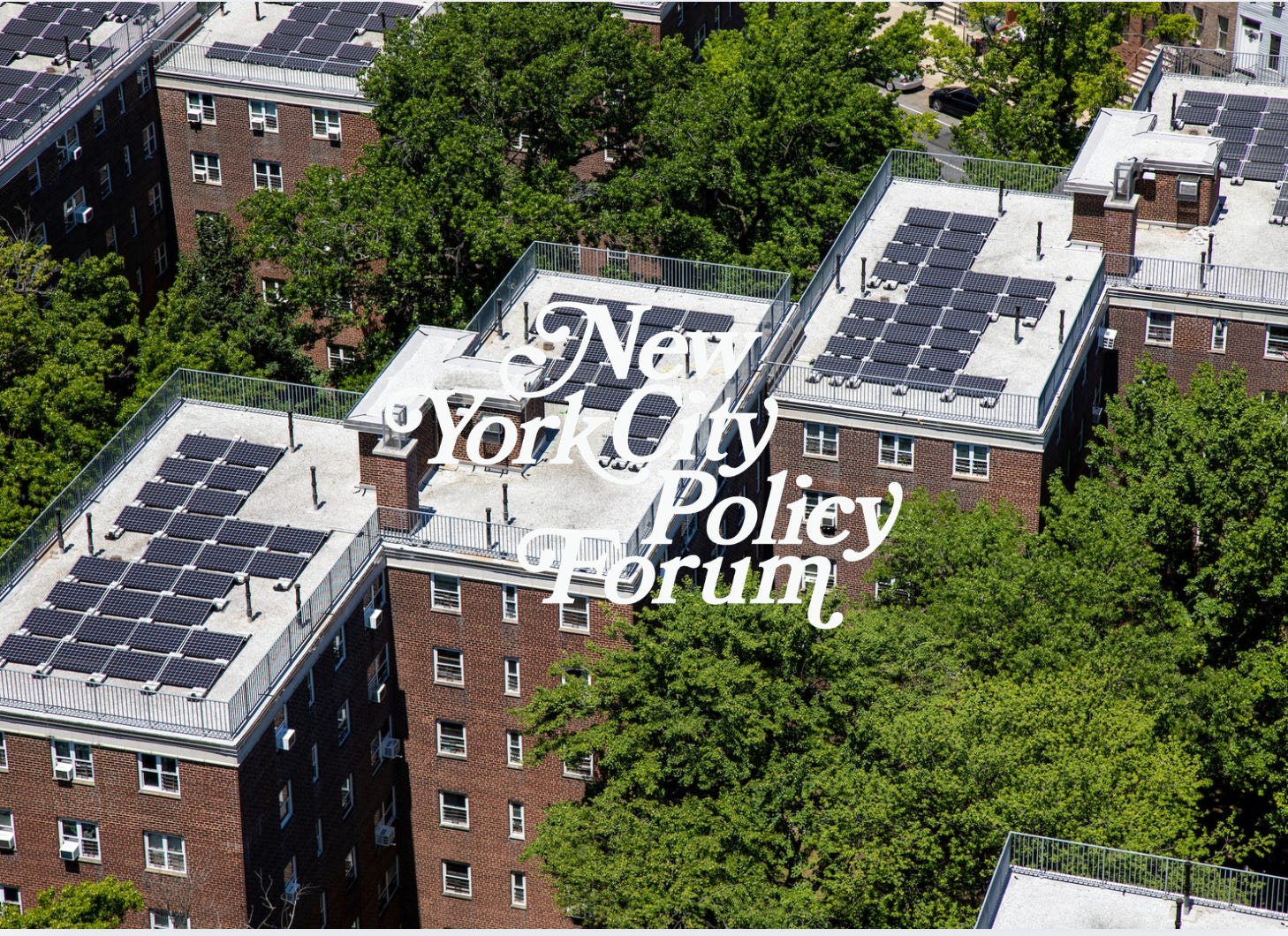
The good news is that green doesn’t always cost more when you have a city-sized checkbook. Procurement professionals trained in lifecycle costing—evaluating energy savings, maintenance costs, durability, and health impacts alongside sticker price—routinely find that the lowest-bid option is not the cheapest option over time. Sometimes, the savings are visible: solar panels on NYCHA buildings, electric vehicles for parking enforcement, quieter construction equipment that doesn’t belch black smoke over neighboring communities. More often, they’re too far upstream but nevertheless real: offsite data centers running on renewable energy, integrated pest management on farms supplying senior center kitchens, low-carbon concrete poured for runways and seawalls.
SPP can also save taxpayers money by turning current cost centers into engines of local investment and innovation. Take waste. All New Yorkers laughed when the Adams administration paid McKinsey $1.6 million to recommend putting our trash in bins to deter rats. But the deeper absurdity is that the city spends $2.3 billion annually on waste management—that’s over $6 million every day just to throw things away—without strategically using those contracts to fully implement municipal composting, minimize shipping routes, reduce the environmental justice burden on communities near transfer stations, and invest in NYC-based circular economy entrepreneurs who can extract value from the 24,000 tons we generate every day.
Beyond cost and sustainability, SPP can also bolster the city’s resilience in the face of growing supply-chain disruptions and climate risks. We all remember when toilet paper supply chains broke during COVID-19. Imagine similar shortages of school lunch food, PPE for public hospitals, heating fuel, or salt for icy sidewalks. NYC purchases at volumes that make it uniquely vulnerable to market shocks it cannot absorb; and unlike private companies, the city cannot simply decline to deliver when supply gets tight or expensive. An affordable city is one where strategic suppliers are equally prepared and resilient to emerging risks, from wildfires to tariffs to energy costs and beyond. The only panic purchasing ahead of a Nor’easter should involve chocolate and wine.
Finally, SPP can influence private industry behavior because when government procurement signals interest, industries innovate. Consider EPEAT—a voluntary environmental standard for IT equipment that became transformative when President George W. Bush required federal agencies to use it for procurement starting in 2007. States, cities, universities, and corporations aligned their policies, including NYC. Facing unified purchasing requirements, major electronics manufacturers simply redesigned their entire product lines to comply, making EPEAT the de facto global baseline. Today, virtually all IT equipment is more energy efficient, less toxic, and more recyclable—not because of regulation, but because of government purchasing power.
What would it take to implement SPP? Fortunately, NYC already knows how to align its spending with its values: decades of purchasing preferences with Minority and Women-owned Business Enterprises (M/WBE) and requiring construction firms to pay prevailing union wages and benefits have built genuine institutional capacity for mission-driven procurement. An SPP program slots directly alongside those initiatives, amplifying them with a focus on environmental justice, green job growth, and climate equity.
Previous administrations have already taken partial steps in this direction. Mayors Bloomberg, de Blasio, and Adams issued Executive Orders creating a piecemeal patchwork of rules for which products the city must and cannot buy—e.g., no single-use plastics, locally grown food, recycled content minimums, green cleaning products. Similarly, NYC has an Environmentally Preferable Purchasing program, but it is currently little more than a series of user-unfriendly PDFs with laundry lists of specific products but no vision for tackling the city’s major service contracts. More promisingly, the Department of Citywide Administrative Services (DCAS) recently piloted a challenge-based procurement model for building energy management systems that lets vendors propose innovative solutions to a challenge statement rather than bid against a fixed specification—this is exactly the kind of empowerment that procurement professionals relish, industry gets excited about, and building residents deserve. Mayor Mamdani should take models like this citywide, and in turn set a standard for other cities to follow nationwide.
Mayor Mamdani can start tackling this challenge with a simple first step: appoint a Senior Advisor for Sustainable Public Procurement reporting to the Deputy Mayor for Operations, and working across MOCS, Mayor’s Office of Climate & Environmental Justice (MOCEJ), and DCAS. This is not a new bureaucracy. It is a coordinator with authority to empower the city’s procurement professionals to align $42 billion in existing spending with the city and administration’s priorities.
It is long overdue that New York City “puts our money where our mouth is” by focusing not only on what we spend on, but how we spend it. It is time to care more about our contracts. New York City became the greatest city on earth not by campaigning for the title but by investing in the unglamorous, indispensable machinery that makes the city hum. When we get it right, every pothole we fill, every building we construct, every meal we serve, and every bus that arrives on time becomes a statement about the New York we’re choosing to build. The money is already being spent. The only question is whether we’re spending it with intention.
The author is a fourth generation New Yorker who served in the Biden-Harris White House, scaling sustainable supply chains and implementing net zero procurement for the Federal government, the world’s largest buyer.