


DCWP and the Mayor’s Office can bring transparency and discounts to money transfers, supporting working-class internationalism and diplomacy in New York City, writes Michael Galant.
Every payday, hundreds of thousands of New Yorkers set aside part of their hard-earned income to support families and friends living abroad. These remittances often act as a lifeline for recipients—making the difference between affording rent and losing a home, between putting food on the table and going hungry.
Yet a significant portion of this money never arrives at its intended destination. The costs of sending remittances—through traditional brick-and-mortar shops or newer digital providers—average 5.6 percent of the transaction. For some US remittance “corridors,” such as those to Tanzania, average costs exceed 10 percent.
To make matters worse, as of January 2026, the United States has imposed a new 1 percent federal tax on remittances made via cash, money order, or cashier’s check—an overtly anti-immigrant initiative of the Trump administration, which originally pushed for an even more onerous 3.5 percent tax on all remittance from non-US citizens. Some states—though not New York—are even considering measures that would require proof of legal residence to make remittance payments.
This new tax is not only a burden on hard-working immigrants and diaspora communities in the United States and their families abroad, but entire nations in the Global South whose economies rely on remittance flows. In 2024, remittances to low- and middle-income countries exceeded Foreign Direct Investment, and tripled official development assistance. Personal remittances represent 10 percent of GDP for Senegal, 15 percent for Yemen, and upwards of 20 percent for Central American countries like Nicaragua, Honduras, and Guatemala. Remittances are such a critical factor for development that the UN recognizes June 16 as the International Day of Family Remittances, and the UN Sustainable Development Goals call for reducing average remittance costs to below 3 percent and eliminating remittance corridors with costs higher than 5 percent.
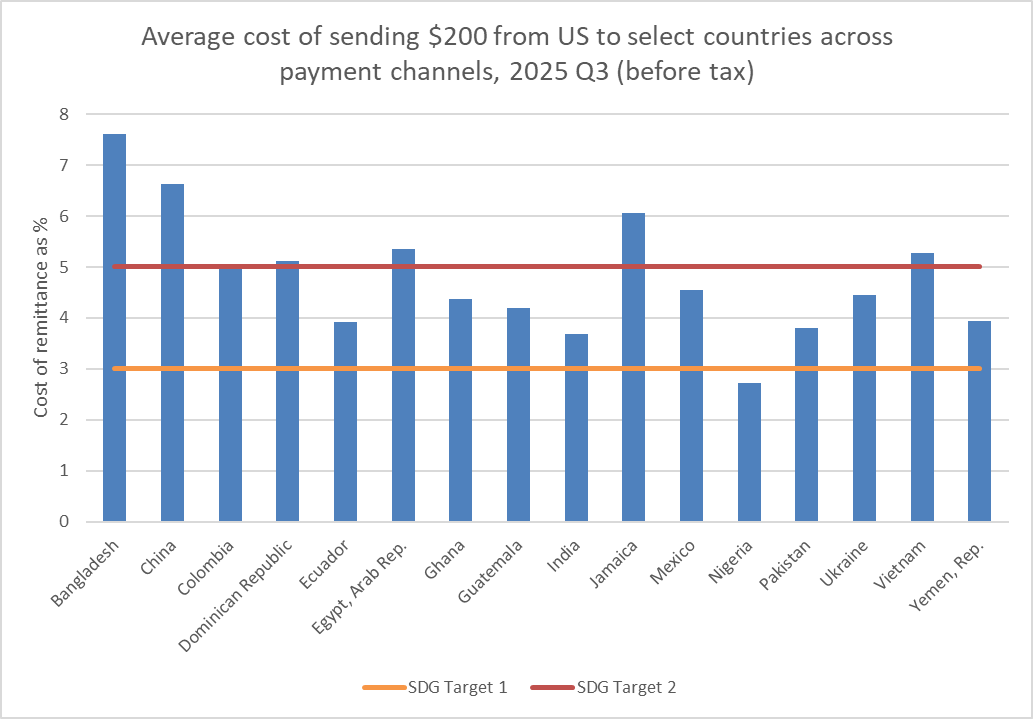
Source: World Bank Remittance Prices Worldwide database
High remittance costs—including the new Trump tax—place significant financial strain on diaspora communities, including in New York. But is this a problem that the Mamdani administration should address? And even if it wanted to, does it have the authority to do so? As this brief post argues, the answer to both questions is yes. While most policies impacting remittance costs are made at the federal level, the current administration has several tools it can use to ease this financial load to the benefit of New Yorkers and non-New Yorkers alike.
A Political Winner
For Mayor Mamdani, the political logic of confronting remittance costs could hardly be clearer.
First and foremost, remittance costs are a material, cost-of-living issue for a wide swathe of New Yorkers, particularly the multiethnic working-class diaspora communities that the mayor has made central to his campaign and administration. Reducing these costs would be a tangible, easily communicable win for a core constituency.
Second, lowering remittance costs also benefits New Yorkers who don’t pay remittances. Personal remittances are relatively price inelastic—that is, high costs do not actually significantly deter New Yorkers from sending money to their loved ones that rely on it. Instead, high prices and taxes simply mean that a larger portion of the sender’s hard-earned cash gets eaten up before it makes it to the recipient or, just as often, that senders are driven underground, to more opaque, risky methods of money transfer. Inversely, lowering remittance costs does not significantly increase the amount of wealth leaving New York—rather, it puts more money in New Yorkers’ pockets, and therefore leads to greater spending in their communities.
Third, as a globally recognized face of the left, Mayor Mamdani’s administration is being closely watched to define a political vision that will serve as an alternative to both Trump and the liberal status quo. By reducing remittance costs—an issue primarily affecting immigrants and diaspora communities—Mamdani would underscore the contrast between his and Trump’s visions on immigration and present New York as the more humane alternative. It would also provide an opportunity to highlight the fact that the Trump administration has chosen to impose a tax on working-class people while cutting taxes on the wealthy, and to dispel the public’s simplistic belief that “socialism” simply means “more taxes.”
Finally, given the tight link between remittances and development, addressing remittance costs would allow the administration to simultaneously deliver for New Yorkers and countries across the Global South; to deepen internationalist engagement without risking coming across as being distracted from the core concerns of constituents. In doing so, Mayor Mamdani can begin to define his foreign policy vision as one rooted in working-class internationalism, diplomatic engagement, and mutual prosperity. Unlike Trump’s xenophobic agenda, the left solution to the “challenge” of migration is not to crack down on migrants, but to combat the underdevelopment of the Global South and reduce the inequalities between nations that force people to leave their homes in the first place.
Available Policy Levers
How, then, can the Mamdani administration lower remittance costs? Let’s consider five possible policy levers.
Exchange rate transparency
Federal regulations require Money Transfer Operators (MTOs) to disclose the fees, exchange rate, and amount delivered to the recipient. Yet much of the cost is hidden in the exchange rate itself, which is often marked up well above market rates. Indeed, the income model of the MTO industry is such that it is hardly a “transfer” industry at all, but an industry of foreign exchange arbitrage. This practice—concealing the true cost of the service in the spread between posted rate and market rate—should be seen and treated as a deceptive pricing practice.
Just as the Mamdani administration has already done with hotel junk fees, the NYC Department of Consumer and Worker Protection (DCWP) could rule that money transfer services must post not only the exchange rate used, but the spread between actual and mid-market exchange rates, as defined by a widely accepted benchmark, such as Refinitiv’s. While this benchmark does not necessarily capture the true cost at which the MTO obtained its foreign exchange, which is often at below-market rates, this added level of transparency would still make it easier for consumers to compare providers and would put downward pressure on remittance costs.
Municipal monitoring and consumer guidance
To further help consumers find the lowest-cost and most relevant provider, the DWCP could begin a program to monitor and track the costs of remittances by MTO and by transaction corridor, as well as tracking factors such as language accessibility, geographic coverage, and financial inclusion. This monitoring would allow the department to publish an accessible guide to the benefits and costs associated with various money transfer service providers. It would also provide a basis for the department to determine and designate “preferred provider” status to certain transfer services, a designation the DCWP could advertise and promote via its Financial Empowerment Centers. This ability to steer potential customers en masse to particular businesses would create an additional incentive for MTOs to improve their performance on the criteria relevant to the DCWP’s determination of preferred provider status.
Negotiated discounts
The city could directly negotiate discounts with certain MTOs for particular groups. For example, just as IDNYC holders receive a 5 percent discount at Food Bazaar supermarkets, similar discounts could be negotiated for IDNYC holders, or other groups, including municipal employees. In addition to the negotiating leverage inherent to offering bulk discounts to IDNYC holders, the above-mentioned “preferred provider” status—and the steering of customers to particular MTOs—would further strengthen the City’s hand in negotiating discounted services.
IDNYC financial inclusion
The Trump remittance tax disproportionately affects undocumented immigrants, who are less likely to have bank accounts to make untaxed digital remittances, and thus more often rely on cash remittances that are subject to the tax. While a handful of banks and credit unions already accept IDNYC as sufficient documentation to open a bank account, the Mamdani administration could help undocumented immigrants avoid the remittance tax by working with other banks and credit unions to encourage them to accept IDNYC. Even if these banks prove unwilling to accept IDNYC for generalized bank accounts, the administration may be able to convince them to develop limited, remittance-specific accounts for IDNYC holders.
Before moving forward with this approach, however, the Mamdani administration should verify with any participating banks and credit unions which of their records can be accessed by the federal government. Given that the Trump administration may seek to force banks to require proof of citizenship, and that it has aggressively pushed to use IRS tax data to locate undocumented immigrants, there is a serious risk that federal immigration enforcement could try to access information about individuals using IDNYC to open bank accounts, which could suggest undocumented status. Unless a proper firewall is in place, the downsides of this approach would outweigh the potential benefits.
International engagement
The prices paid on remittances are shaped not only by US policy, but by the actions of receiving countries as well. The Morena government of Mexico, for example, has introduced the innovative Financiera para el Bienestar (FINABIEN) card—available at Mexican consulates—as a means for Mexican nationals abroad to more easily send remittances to Mexico at low cost, and without paying the Trump tax. In collaboration with the Sheinbaum government, the Mamdani administration could promote the use of these cards to Mexican residents of New York, including through the DCWP’s Financial Empowerment Centers.
Mamdani could also convene international government representatives, at the municipal and other levels, to coordinate efforts to lower remittance costs. The Mayor’s Office for International Affairs could, for example, invite a representative of the Sheinbaum administration to present on the development of the FINABIEN card and provide other governments the tools to enact similar policies. Since lowering remittance costs is already a UN Sustainable Development Goal, these measures would complement the Office of International Affairs’ existing programs on SDG diplomacy.
***
Admittedly, the policy options available to address remittance costs at the municipal level lack the singular clarity of the most prominent planks of Mayor Mamdani’s affordability agenda; “Increase transparency of personal remittance exchange rate spreads” is not “fast, free buses.” But a combination of these technocratic measures may nevertheless have a meaningful impact on the bottom line for working-class New Yorkers. And by presenting the various policy steps as a part of a general plan to lower remittance costs, the Mayor’s Office—with its exceptional communication skills—could ensure that its efforts are well understood by the public.
High remittance costs won’t be addressed at the municipal level alone. But the Mamdani administration has the tools—and the opportunity—to put money back in the pockets of working-class New Yorkers, define a pro-immigrant alternative agenda to Trumpism, and demonstrate how internationalism can materially benefit working people at home and abroad.
Michael Galant is the senior research and outreach associate at the Center for Economic Policy and Research.