

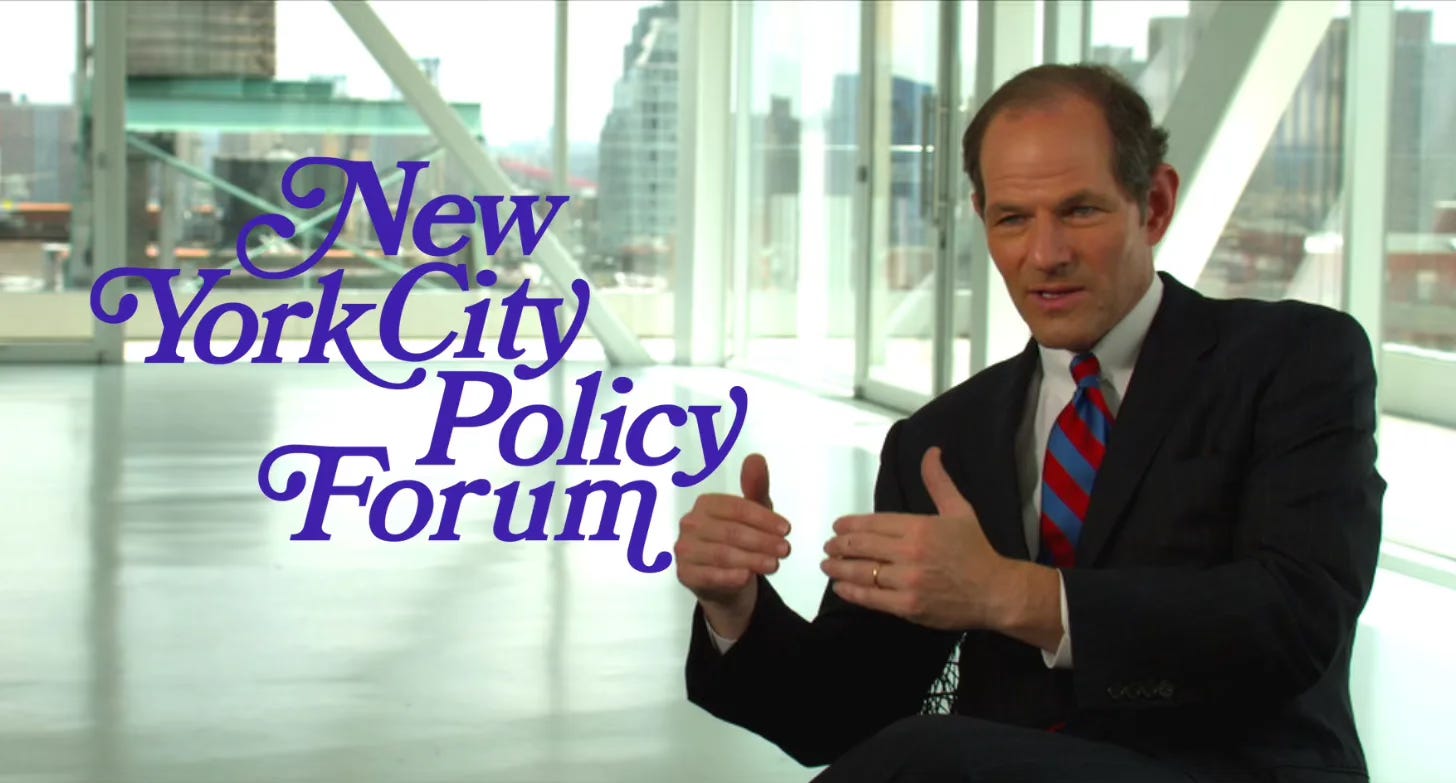
Ava Ayers revisits Governor Eliot Spitzer’s failed push to allow undocumented New Yorkers to get driver’s licenses—illustrating the perils of turning a quiet administrative fix into a political spectacle.
As Zohran Mamdani enters office, elected with a broad mandate and determined to make the state more just, it’s worth paying attention to the mistakes of others. In January 2007, Eliot Spitzer stepped into the governorship in January 2007 as a powerful progressive determined to make the state better for noncitizens. “Today’s immigrants enrich our state with their vitality and their vision,” he said in his inaugural address,” making clear that immigrants were part of the “one New York” his speech envisioned.
By March 2008, Spitzer was gone. Suspicious money transfers drew the attention of federal regulators, who discovered that he had been patronizing sex workers. When the New York Times broke the story, Spitzer quickly resigned. But his governorship had been in trouble before the prostitution scandal came to light. Spitzer had picked the wrong battles. In particular, he had picked the wrong battle over driver’s licenses for noncitizens.
It wasn’t the wrong battle because the policy was wrong, but because Spitzer framed it in the way most likely to provoke a political explosion. This was his style: “I am a fucking steamroller and I’ll roll over you or anybody else,” he told a Republican assemblyman, and subsequently stood by the comment in a press conference. It’s hard to imagine a sharper contrast with Mayor Mamdani’s open-handed style, but the new Mayor and Spitzer share a willingness to propose big ideas. And that’s where Spitzer made his mistake: framing his driver’s license proposal as broader than it really was and generating political battle out of something he already had the power to do.
Spitzer’s Plan
In September 2007, six months before he resigned, Spitzer announced his plan to allow undocumented immigrants to get driver’s licenses. He issued a press release with statements from Democratic legislative leaders and immigration advocacy groups, saying this “administrative policy change” would “give all New Yorkers the opportunity to apply for state driver licenses without regard to immigration status.”
Spitzer portrayed this policy as part of a broader movement to include undocumented people in American society. “As long as I am governor,” he said, “we will not pretend that they do not exist, we will not cut them off from participating in our society, and we will not become part of a myth that is propagated at the federal level that they are not here.” He framed the policy as bringing people out of the shadows.
Met with resistance, Spitzer first scaled the policy back, saying he would create a different tier of license for undocumented persons. Then he said he would reinstate Governor Pataki’s policy of listing visa expiration dates on licenses issued to “temporary visitors.” After prolonged campaigning by vicious xenophobes such as Lou Dobbs, who at the time had CNN’s second-most-popular talk show, polls showed more than 70% disapproval of the plan. In November, Spitzer abandoned the issue altogether, saying, “I am not willing to fight to the bitter end on something that will not ultimately be implemented.” The passive “be implemented” sounded as if someone other than Spitzer had the authority to approve or disapprove the plan.
Before Spitzer, There Was No Law Against Driver’s Licenses for Undocumented People
Spitzer’s mistake on driver’s licenses had nothing to do with the policy he proposed. The choice to give undocumented people driver’s licenses should be easy. Roads are safer when drivers have licenses and the insurance a license allows them to buy. Undocumented people need to work, so some will drive whether they have licenses or not. Studies confirm that licenses increase road safety and benefit the state economy. Only when seen through the paranoid eyes of anti-Latino bigotry does it make any sense to deny driver’s licenses to undocumented people. Opponents of Spitzer’s policy warned, bizarrely, that driver’s licenses would somehow lead to voting privileges, and accused him of “debasing their citizenship rights.”
It wasn’t the substance or the scale of the policy that was the problem. Almost twenty years later, Spitzer’s failed proposal is the law of the land. Undocumented New Yorkers are eligible for driver’s licenses under the 2019 Green Light Law. If anything, Spitzer’s attempt to protect undocumented people was too modest. Ten years later, in 2017, Andrew Cuomo would issue an executive order that generally barred state employees from asking people about their immigration status or sharing it with federal authorities. Spitzer could have done the same, or at least have directed the Department of Motor Vehicles to not retain immigration-status information, thus ensuring that it wouldn’t be passed on to federal authorities.
The mistake we can now see, with the benefit of hindsight, is that Spitzer premised a public-relations campaign on the idea that he was changing the landscape. What hardly anyone acknowledged during the 2007 debates over Spitzer’s proposal was that undocumented people were not ineligible for driver’s licenses under New York State law: Nothing in federal or state law barred them from licensure. The only obstacle was a minor paperwork requirement adopted by the Pataki administration in 2002. Spitzer was merely streamlining procedures to achieve the only thing New York law required: reliable verification of identity.
State law and regulations in 2007 required driver’s-license applicants to provide either a Social Security number or proof they were legally ineligible for one. DMV could have chosen to accept a simple affidavit saying the applicant was ineligible, as today’s Green Light Law does. Instead, in 2002, Pataki adopted a policy requiring a copy of a form from the Social Security Administration affirming the applicant’s ineligibility for a Social Security number. That form was only available to those legally present in the country, so the policy effectively excluded the undocumented. (This is explained in a June 2007 state Court of Appeals decision that upheld Pataki’s paperwork requirement.)
All Spitzer had to do, then, was tell his DMV to walk back Pataki’s new documentation requirement. It wasn’t needed, after all. The Social Security Administration’s form was just some words typed on black-and-white paper, easy to forge, so requiring applicants to submit it would hardly help prevent fraud.
And by the time Spitzer took office, identity-verification technology had improved, and the DMV could verify people’s identity without federal paperwork. As Spitzer explained when he announced the policy, the state now had technology allowing it to authenticate foreign passports and compare photos to make sure no driver had more than one license.
Nor did Spitzer’s policy conflict with federal law. On the contrary, the 2005 federal Real ID Act had explicitly affirmed states’ right to do just what Spitzer’s compromise proposal would have done: issue different tiers of licenses, with one (the “Real ID”) valid for airports and federal buildings, and the other valid for everything else. Spitzer’s DMV could have announced that New York’s compliance with this law would include just what the federal law anticipated: a state ID that any New Yorker could apply for.
The DMV could have implemented these changes without Spitzer making it a signature issue for his young administration. The DMV could have framed the change as a simple systems update and compliance with a new federal law. Yes, undocumented people would be able to get licenses, but that’s not New York State’s problem.
Hindsight Is 20/20, So Let’s Use It
Would a humbler frame have prevented the backlash against Spitzer’s policy? Maybe not. The policy would have to be publicized to some extent if undocumented people were to know they could benefit from it. And maybe nothing would have stopped Lou Dobbs’s multiday xenophobic tirades once he discovered that somewhere, an undocumented person was driving safely. But it couldn’t have hurt to say, truthfully, that Spitzer’s policy was only allowing undocumented people to claim the licenses that New York State law already entitled them to.
Sometimes it’s important to paint your policies as a profound break with the past. I’ve written at length about why sanctuary cities should say, loudly, that they’re motivated by the outrageous injustices of federal immigration enforcement and the immigration laws themselves. Immigration law as it exists today is horrifically unjust. It was unjust before Trump’s mass-deportation campaign. The only way to move society toward fixing this problem is to loudly decry the injustice and demand a sharp break with what’s come before.
But when you wield enormous executive power, it’s equally important to consider your ability to change policy simply and quietly and to downplay the extent to which your policies break with the past. Any new administration will have to evaluate countless policies and choose which ones to change quietly and which ones to broadcast.
Sometimes the best path forward is to say you’re making a big change, because people won’t rally around your flag unless you raise it high in the air. For example, if you need the state legislature to change a law, you probably need a press conference. But when it’s possible for a good policy change to slip through the cracks, it might be better to leave the steamroller in the storage yard.
Ava Ayers is an Associate Professor of Law at Albany Law School.